Page 4 of 4
1 2 3 4
ble Archives - Page 4 of 4 - BLE App Developers
BLE App Developers Navbar

Tag: ble

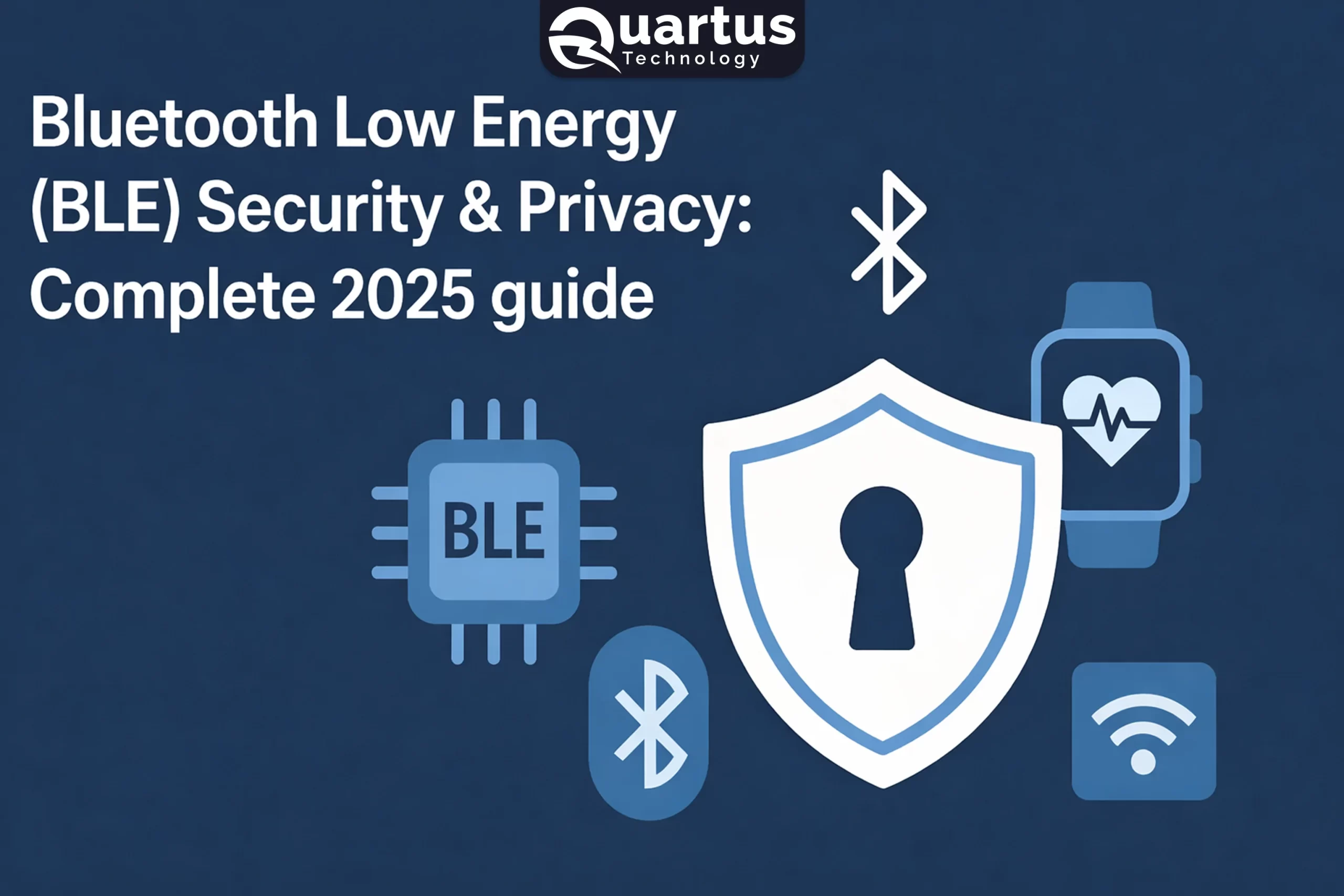
  • Bluetooth Low Energy (BLE) Security & Privacy: A Complete 2025 Guide

    In 2025, Bluetooth Low Energy (BLE) has become the backbone of connected devices—from smartwatches and fitness trackers to healthcare monitors, asset tracking systems, and industrial IoT solutions. But as BLE adoption grows, so do security and privacy challenges.

    For businesses, developers, and product designers, ensuring data protection and secure device communication is no longer optional—it’s essential. In this guide, we break down the latest BLE security practices and privacy safeguards shaping the future of wireless connectivity.


    Why BLE Security Matters More Than Ever

    With billions of BLE-enabled devices in circulation, vulnerabilities can have massive consequences. Poorly protected devices are easy targets for:

    • Eavesdropping – Attackers intercepting data during communication.
    • Man-in-the-Middle (MITM) Attacks – Unauthorized parties altering or injecting messages.
    • Tracking Risks – Exploiting static MAC addresses to monitor user movement.

    As a result, modern BLE solutions must integrate robust encryption, smarter pairing methods, and stronger privacy controls.


    Key BLE Security Enhancements in 2025

    🔐 1. LE Secure Connections

    BLE now relies on Elliptic Curve Diffie-Hellman (ECDH) for key exchange, ensuring encryption keys cannot be intercepted. This makes device-to-device communication significantly harder to compromise.


    🔑 2. Advanced Pairing Methods

    BLE devices use several pairing approaches, each designed for different use cases:

    • Just Works – Fast and simple, but least secure (no MITM protection).
    • Passkey Entry – Users confirm a 6-digit code for higher security.
    • Numeric Comparison – Both devices display a number, and the user verifies if they match.

    By selecting the right pairing method, developers can balance user convenience with security strength.


    🛡️ 3. Privacy Through MAC Address Randomization

    Instead of broadcasting a fixed MAC address, modern BLE devices use address randomization. This prevents third parties from tracking users across different locations, protecting user anonymity and movement patterns.


    📉 4. Minimizing Advertising Data

    BLE devices often broadcast data packets to announce their presence. However, the more data included, the easier it is to exploit.
    In 2025, best practice is to minimize advertising payloads, sharing only the essentials.


    Best Practices for BLE Developers

    If you’re building or deploying BLE-powered solutions, here’s how to stay ahead:

    • Always use LE Secure Connections by default.
    • Choose Passkey Entry or Numeric Comparison for sensitive apps (healthcare, fintech, IoT security).
    • Enable MAC address randomization to protect user privacy.
    • Keep advertising data lightweight and encrypted where possible.
    • Regularly update firmware to patch security vulnerabilities.

    Final Thoughts

    BLE continues to drive innovation in IoT, healthcare, retail, and smart environments, but without strong security and privacy, connected devices can quickly become a liability.

    At QuartusTech, we help businesses design and deploy secure, scalable, and user-friendly BLE applications that comply with global standards and protect customer trust.

    💡 Looking to build a BLE-powered app with enterprise-grade security? Get in touch with our experts today.
  • How BLE is Powering Next-Gen Mobile & Web Applications

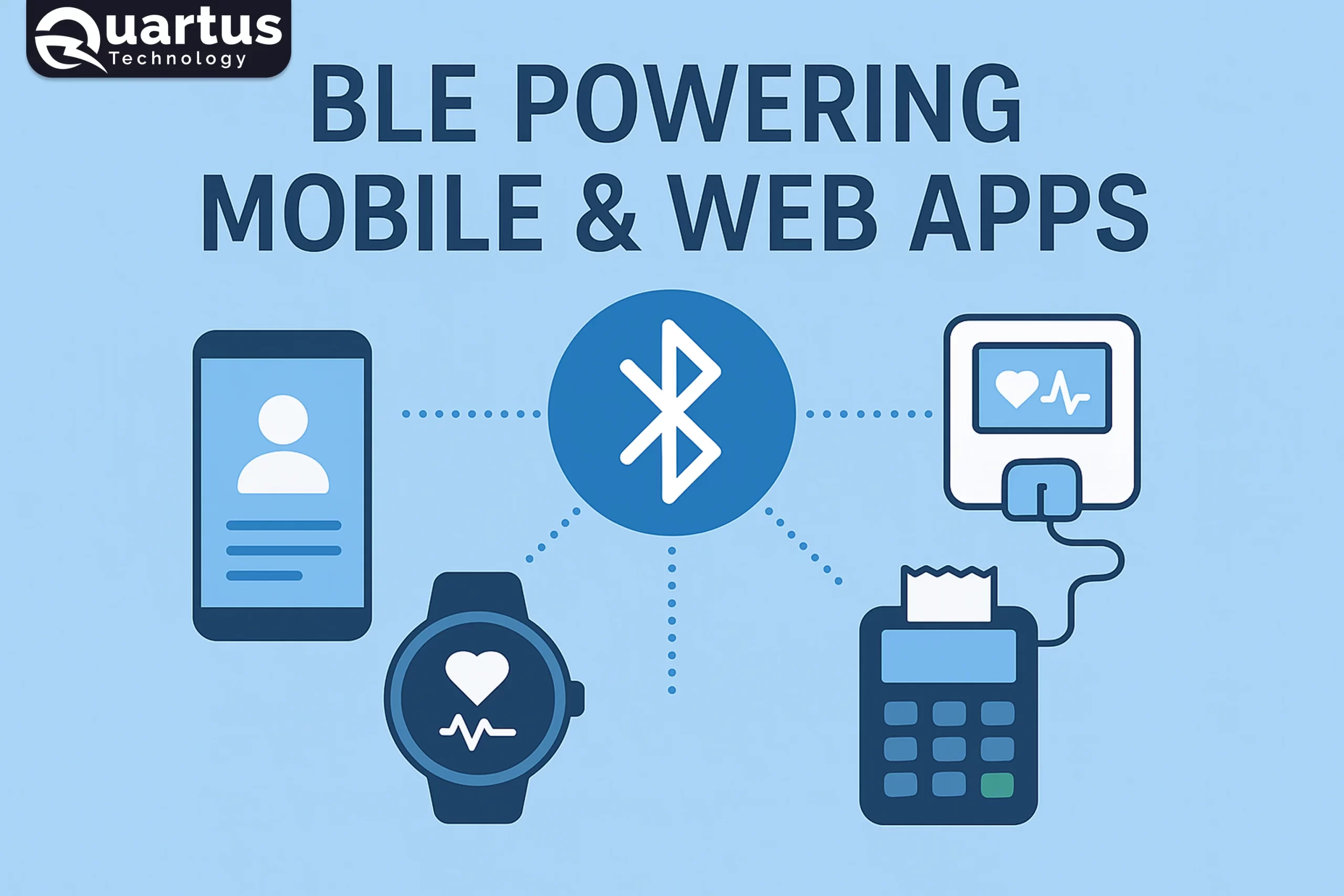
    n today’s hyper-connected world, businesses and consumers demand faster, smarter, and more energy-efficient applications. This is where Bluetooth Low Energy (BLE) steps in as a game-changer. Unlike traditional Bluetooth, which focuses on continuous data streaming, BLE is designed for low-power, high-efficiency communication—making it the backbone of next-generation mobile and web applications.

    As we move through 2025, BLE is not just a feature—it’s becoming a necessity for modern app development. Let’s explore how BLE is powering innovation across industries.


    1. Ultra-Low Power Consumption

    One of BLE’s biggest advantages is its energy efficiency. Mobile and IoT devices powered by BLE can run for months—or even years—on a single coin-cell battery.

    • Mobile Apps: BLE ensures that apps like fitness trackers, location-based services, and mobile wallets don’t drain device batteries.
    • Web Apps with BLE APIs: Progressive Web Apps (PWAs) now leverage BLE APIs to communicate directly with nearby devices, without needing heavy background processes.

    This makes BLE ideal for always-on applications that require real-time data without compromising battery life.


    2. Seamless IoT Integration

    IoT is at the core of modern digital transformation, and BLE is its connectivity hero.

    • Smart Homes: BLE-enabled mobile apps can control lights, thermostats, and locks with just a tap.
    • Healthcare: BLE allows wearables like heart-rate monitors and glucose trackers to send data directly to apps, empowering real-time health management.
    • Retail & POS: Web-based BLE apps are being used for contactless payments, smart inventory tracking, and personalized in-store experiences.

    The ability of BLE to connect multiple devices simultaneously makes it a perfect match for IoT ecosystems.


    3. Location & Proximity Services

    BLE beacons have unlocked new possibilities in location-based mobile and web applications.

    • Retail Apps: BLE-powered apps send personalized offers when customers walk near a product.
    • Hospitality: Hotels use BLE apps for keyless room entry and indoor navigation.
    • Events & Stadiums: BLE-powered apps enhance fan engagement with real-time updates, seat navigation, and contactless ticketing.

    The accuracy of BLE location tracking (within a few meters) enables context-aware mobile experiences that were once impossible.


    4. Faster & Secure Connections

    BLE offers instant pairing and encrypted communication, making it suitable for mission-critical applications.

    • Healthcare apps rely on BLE for secure patient data transmission.
    • Enterprise apps use BLE for device authentication and workforce tracking.
    • Financial apps integrate BLE for contactless transactions, ensuring both speed and security.

    In a time when cybersecurity is a priority, BLE ensures that businesses can deliver trustworthy digital experiences.


    5. BLE in Next-Gen Web Applications

    Web developers are now leveraging the Web Bluetooth API, which allows browsers to communicate directly with BLE devices.

    This means:

    • Users can connect wearables, sensors, or POS machines directly through their browser.
    • Businesses can build cross-platform BLE applications without forcing users to download heavy apps.
    • Developers can deliver real-time BLE-enabled dashboards for industries like logistics, healthcare, and manufacturing.

    This integration is shaping a new era of lightweight, scalable, and device-connected web applications.


    The Future of BLE in Mobile & Web Development

    With the arrival of Bluetooth 5.3 and beyond, BLE is faster, more reliable, and capable of supporting even larger device networks. Its role in IoT, healthcare, retail, and smart mobility is only expected to grow.

    Mobile and web developers who adopt BLE today are building solutions that are energy-efficient, scalable, and future-proof.


    Conclusion

    BLE is no longer just a connectivity option—it is the driving force behind next-gen mobile and web applications. From powering IoT devices to enabling secure financial transactions and enhancing user experiences with proximity services, BLE is reshaping the digital landscape in 2025.

    At QuartusTech, we specialize in building BLE-integrated mobile and web applications that help businesses innovate faster and smarter. Whether you’re developing healthcare apps, POS solutions, or IoT ecosystems, our BLE expertise ensures your applications are ready for the connected future.

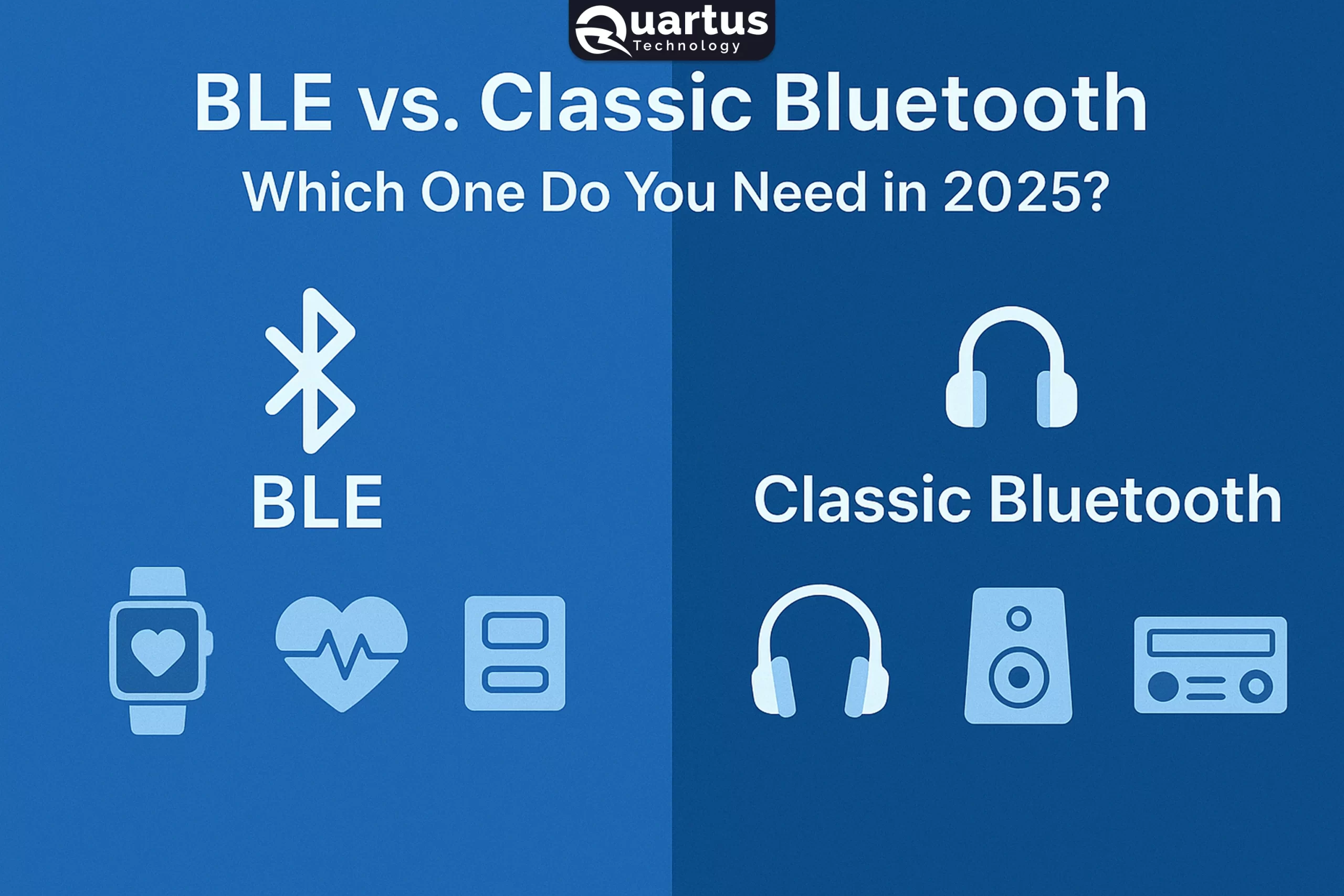
  • BLE vs. Classic Bluetooth: Which One Do You Need in 2025?

    When it comes to wireless communication, Bluetooth has been a household name for decades. From connecting headsets and speakers to syncing smart devices, Bluetooth has become the backbone of short-range connectivity. But as technology evolves, a newer version—Bluetooth Low Energy (BLE)—is taking the spotlight.

    In 2025, businesses and developers often face a critical question: Should I use BLE or Classic Bluetooth for my application? Let’s break down the differences, use cases, and the right choice for your needs.


    What is Classic Bluetooth?

    Classic Bluetooth, introduced in 1999, is designed for continuous wireless streaming. It offers higher data transfer rates and has long been the go-to technology for audio devices like headphones, speakers, and car infotainment systems.

    • Data Rate: Up to 2–3 Mbps
    • Power Consumption: Relatively high, drains battery faster
    • Range: Typically 10–100 meters
    • Best For: Audio streaming, file transfer, gaming controllers

    What is BLE (Bluetooth Low Energy)?

    BLE was introduced in 2010 (Bluetooth 4.0) and optimized for low power consumption. Instead of continuous streaming, BLE works in quick bursts, making it perfect for devices that need to send small amounts of data occasionally while saving battery.

    • Data Rate: Up to 1 Mbps (Bluetooth 5+ allows faster speeds)
    • Power Consumption: Extremely low, optimized for long battery life
    • Range: Up to 100–400 meters (with Bluetooth 5.3 in 2025)
    • Best For: IoT devices, healthcare sensors, wearables, POS systems, asset tracking

    BLE vs. Classic Bluetooth: Key Differences

    FeatureClassic BluetoothBLE (Bluetooth Low Energy)
    Power UsageHigh (battery drains faster)Ultra-low (ideal for long-term use)
    Data TransferHigh speed, continuousSmall packets, periodic
    Range10–100 metersUp to 400 meters with BT 5+
    Use CasesAudio streaming, file sharingIoT, healthcare, smart devices
    Connection TimeSlower to connectFaster pairing, low latency
    CostSlightly higherCost-efficient for IoT

    Which One Should You Choose in 2025?

    Choose Classic Bluetooth if:

    • You need continuous audio streaming (headphones, speakers, car audio).
    • Your application demands higher data transfer rates.
    • Power consumption is not your top priority (devices that recharge often).

    Choose BLE if:

    • You are building IoT applications like smart locks, wearables, or healthcare monitors.
    • Your device needs to last months or years on a single battery.
    • You need scalability with multiple devices connected at once (e.g., POS systems, smart homes).

    The Future of Bluetooth in 2025

    With the advancements of Bluetooth 5.3, BLE has become even more reliable, offering extended range, higher speeds, and better coexistence with Wi-Fi. Classic Bluetooth still dominates the audio streaming industry, but BLE is clearly leading the IoT revolution.

    Businesses in retail, healthcare, and logistics are rapidly adopting BLE for low-cost, high-efficiency connectivity. If your focus is on scalable, power-efficient, and future-ready solutions, BLE is the way forward.


    Conclusion

    In 2025, the choice between Classic Bluetooth and BLE depends on your application’s needs. Classic Bluetooth is best for continuous, high-speed streaming, while BLE shines in low-power, long-lasting IoT and mobile applications.

    At QuartusTech, we specialize in building BLE-powered mobile, web, and enterprise applications that connect the future. Whether you’re building the next smart wearable, POS system, or IoT ecosystem, BLE ensures your solution is efficient, scalable, and future-proof.